
Anyone and everyone will tell you that you shouldn’t check monitor portfolio performance too often because it is going to cause you to make an impulsive decision and sell when you shouldn’t, right?
I googled “how often should i check my investments” and what do you think came up? I took the first five results and listed them below:
*I want to add the caveat that with this article, they explicitly said that “The most important thing is not how often you check your stocks. Instead, the important thing is how you react to the moves you’re seeing. And checking stocks too often can lead to knee-jerk reactions.”
PREACH!
So, my title probably gave away my hot take a little bit, but I disagree with all of these recommendations, and I think that you should check your portfolio DAILY…at a MINIMUM!
You probably think that I am a lunatic right now, and more often than not, I would agree with you, but this is not one of those times!
The general assumption is that the more you look at your portfolio, the more likely you are to make an impulse decision and buy or sell a stock before you normally would because you’re caught up in the hype, and I 100% agree with that.
You probably will do that.
You’re going to have a stock that beats earnings and you’ll sell it after a 4% jump just to have it continue to climb and climb but don’t worry, you just made $40 off your $1000 investment! Talk about a banger!
Or, you’re going to have a stock get pounded with a negative press release, just for you to sell it on the news, and then the stock will rebound pretty quickly because nothing likely actually changed about the fundamentals of the business, right?
This is the definition of buying the rumor and selling the news and this is a surefire way to lose money…and that’s why I am encouraging you to look at your portfolio every single day.
Hear me out…
We’re in the middle of a pretty drastic sell off in the stock market with the coronavirus impacting the entire world being hit pretty hard, and chances are that the most impact that you personally are experiencing is in your investing portfolio.
Unfortunately, the virus is spreading very quickly, and the outlook isn’t great, but statistically, many of us are not going to contract the virus, but you’ve likely already felt the wrath on your retirement accounts from a purely financial sense.
Anyone and everyone that I talk to is constantly talking about the impact on the market and how it’s getting pounded. If your plan is to look at your investments every 6 months, which means you won’t look until July 1st at the halfway point of 2020, but all that people are doing is talking about how the stock market is getting crashed, I’d bet the farm that you’re going to log into your retirement or brokerage account and take a little peak about how things are going..
And WHAM! Your portfolio is down 30%! You had $500,000 saved up and now you’re down to $350,000! What do you do now? I mean, in 2008, the market dropped like 50%, right? So, you should obviously sell now and protect yourself from that remaining 20%, right?
What if you do that and the market then goes right back up? All you did was sell low and now you’re going to have to buy back in at a higher cost than initially planned.
So, what went wrong? You had this foolproof plan to only monitor your portfolio every six months. What happened?
Life happened.
Conversations at work happened.
Paranoia happened.
Crap happened.
And it’s all because you didn’t know what to do you and PANICKED!
This is why I urge you to look at your portfolio every single day. There are really two reasons why you need to do this:
1 – you become desensitized to the large swings in the market
The market is way up one day and then way down the next. You know that the market is falling but you keep trusting your plan. You’re never shocked with that ‘wow’ moment of logging in one day and seeing you’re down 30%. You see it everyday and everyday you’re making the conscious decision to stick to your plan and not sell, and maybe you’re even buying on the way down (like a boss!).
These large swings don’t phase you because you see the news coming out and you know how they can swing your portfolio. You know this because you have seen it in the past because you’ve been monitoring your portfolio daily for years, not just now when there’s a pandemic going on. You’re a seasoned vet that is used to seeing the ebbs and flows so when there are spikes, they’re not something brand new to you – compared to logging into your retirement account one day and seeing a 30% drop.
2 – you fell a victim to selling low and buying high, but you did this early in your investing career, so your mistakes were cheaper!
I can speak to this from experience. Early in my investing career, I constantly would monitor my portfolio and make buy/sell decisions off any piece of news, good or bad, and it cost me money almost every single time. I thought I could time the market and outperform based off of news but guess what, I’m literally just a random jabroni on the street, so anytime that I am hearing news about a company, it’s because it was posted on Yahoo Finance and literally anyone in the entire world can see the same news, so my strategy was flawed from the get-go.
I made some awful, awful decisions, and it cost me money. But I was just getting started investing, and the money that it cost me was pennies compared to my portfolio now. I paid a very small price to learn an extremely important lesson that is now allowing me to reap the rewards. The time to make those mistakes is when your exposure is minimal and you’re just getting started – not when you’re getting ready to retire.
I always have had the mindset that nothing is too bad as long as you learn from your mistakes, but even better than that is trying to learn from other people’s mistakes. I have made personal finance and investing mistakes and I am as open and honest as I physically can be to try to help keep you all from making those same mistakes, but some mistakes you simply just have to make on your own, and this is one of them.
It might be easy for you to sit there and think “well, of course when the market drops then I’m not going to sell all of my investments and that I’m going to dollar cost average the whole way down.” If you said that, then I am going to give you a virtual fist bump, but I also am going to be skeptical if you’ve never been through a market downturn.
Personally, this coronavirus downturn is the first downturn that I have ever been through, but I have invested in a stock that has lost 50% before. And it was a stock that I was in love with. And I sold the stock at the bottom just to buy back in at a higher price. I literally did the worst thing that I possibly could’ve done.
But doing so was a relatively cheap lesson and a lesson that every investor needs to learn, and I recommend that you try to learn it sooner rather than later.
I have some close friends in my life that sold their entire retirement portfolio in 2008 near the bottom of the crash and then refused to invest going forward. You know what that did for them? They essentially lost 50% of their retirement savings and then since they didn’t invest going forward, they missed out on all of the future returns that they should’ve had.
If they had just held on and not sold anything they’d be in so much better shape! See below:
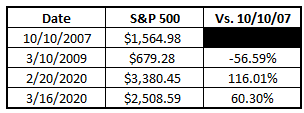
On 10/10/07, the stock market peaked (for that time period) at $1,564.98. On 3/1/09, the market bottomed at $679.28, a drop from the peak of nearly 57%. If they had simply just held onto their investments and not sold at all, they would’ve experienced monster gains of 116% over the 10/10/07 Peak!
More than double the previous high!
That is a huge amount. It’s almost 400% of the bottom on 3/10/09. So, they literally did the worst thing that they could’ve done by selling low and then not buying back in. If they had previous experience of monitoring their portfolio daily, I honestly think that this could’ve saved them hundreds of thousands of dollars. Instead, they’re sitting there wondering “what if” and likely going through the awful would’ve/could’ve/should’ve scenarios.
Obviously, this is so much easier said than done to avoid selling at the low. And by looking at your portfolio every single day it definitely doesn’t keep you from making such a crucial mistake, but I am incredibly confident that it will reduce the risk of you doing something so detrimental to your portfolio.
I really do agree with the Motley Fool article that I previously referenced and they’re totally right – you shouldn’t be looking at your portfolio daily with the intention to buy or sell, you should be looking at it daily with the intention of gathering information and a better understanding of what is happening in the market.
To specifically tie it to the coronavirus, by monitoring my portfolio each and every day, I have been able to be numb to my emotions of each individual stock and more so focus on what is happening in the market.
When I focus on the market as a whole and the impacts that the coronavirus has on my stocks, I then try to think about if the coronavirus is going to fundamentally change the business for any of these companies. Chances are, the answer is no.
If the company is a small airline that might not have the balance sheet to make it through the coronavirus then that is a totally different story, and a story that would have a legitimate impact on the business, but I am not invested in a company like that.
I have a company that I’m invested in that has dropped almost 70% since the coronavirus impact and guess what, I still have faith in that company. That company is dropping hard because discretionary spending is going to slow and there’s not going to be many people traveling on the road, so their sales are going to slow dramatically.
While the stock has dropped 70%, the balance sheet is in great shape and while many might not have the appetite (hint at the stock lol) to invest in this company, I have bought even more shares at a much better price than I initially had bought in at.
The beauty of dollar cost averaging is that if I bought $1000 of a company at $100/share, then I had 10 shares. If the company dropped 70% and I put in another $1000, then I bought 33.33 shares of that company, so now my average cost is right around $46! So, it’s selling at $30, but if it gets back up to only $46 then I’m at a breakeven.
And if nothing has fundamentally changed since it was a $100/share company, then I would obviously think that it can get back to that point in time, and that’s how I can create generational wealth.
If I hadn’t been monitoring my portfolio daily and understanding the different things that can make the market swing like this AND made a lot of mistakes early in my investing career, then I never would’ve been able to take advantage of today’s market and the current economic conditions.
Instead, I went against the grain, I zigged when I was told to zag, and now I am thriving. I didn’t do anything spectacular or heroic – I just took the logic that everyone preaches, questioned it, and decided not to follow the status quo.
And guess what – you can do exactly what I did, too. I didn’t do anything special – I just decided that I wasn’t going to blindly follow everyone else.
